


Frequently asked questions on Behaviour Design, Design Thinking.


One of our key tools is what’s called an As-is Map. This is a framework to represent our user’s journey, almost exactly the way it currently is. Not what it should be (a To-be map).
This method enables us to identify barriers & enablers in a manner that is more accurate & objective. And will provide us with a good anchor right through the 4 phases of our process - Immerse & Empathise, Diagnose & Define, Ideate & Prototype, Test & Iterate.
Using this As-is Map as our base, we will analyse behaviours & beliefs of users & all members of the ecosystem to:
- Discover Irrational behaviours: Behaviours that violate rational thinking as per the economic rational agent model
- Diagnose Behavioural Science principles (System 1 heuristics & biases) at play in the decision-making context of our users, that helps them justify their irrational beliefs & behaviours
- Identify the inherent Emotional Needs (An emotional drivers take on the Jobs-to-be-done theory) that are driving users & stakeholders in the system to display the identified irrationalities
- Suss Intervention impact potential: Verify which parts of the As-is map the interventions are tackling. And also verify that the interventions we prioritise & take forward are meeting the emotional needs of our users.
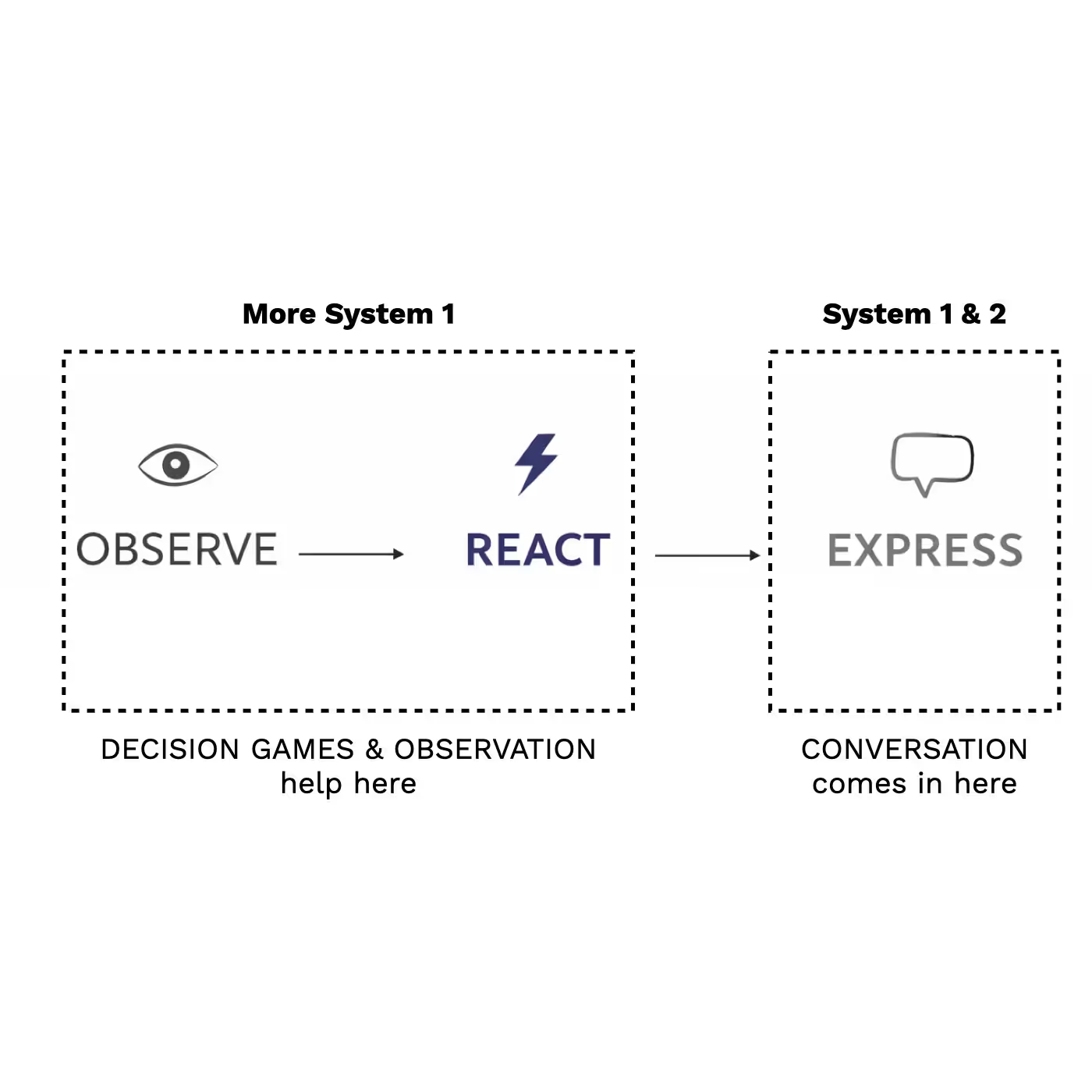
Our research will try to discover irrationalities in decision-making at the as-is map steps. To do this, and to try & avoid socially desirable responses, we try using methods that go beyond conversation so that we can watch decision-making in action before having a conversation about why certain choices were preferred over others.
The reason for selection of this method is what Daniel Kahneman uses to describe 2 schematic parts of our brain function: System 1 (non-conscious, fast, automatic) & System 2 (conscious, slow, deliberate). A conversation alone is more likely to give us slowly thought out, deliberate & conscious reactions. But we know that 95% (and new research now says 99.99%) of the ~35,000 decisions we make in a day are non-conscious. The reason why we perform certain behaviours or have certain beliefs is not always salient to us. Not even to Daniel Kahneman himself.
And so our research methods are a mix of watching / observing reactions & then getting users to express why they chose what they chose. While several firms refer to this as System 1 research, that title is highly debatable.
In essence, we want to watch people make decisions (using both System 1 & System 2) & then diagnose why.
Within conversations, we use decision games & other methods to watch how people make choices & to try & diagnose why they choose what they choose. This then leads into one of the areas of enquiry listed through a natural conversation.
In our experience, this approach works better than having a pre-listed set of questions to get through during the interview, as it rides on the existing motivation of the participant to tell us more about a specific experience s/he has had.
Our trained researchers will use the areas of enquiry to navigate this conversation so as to get answers to as many areas of enquiry as we can during the 45-60 mins that we usually have with the participants.
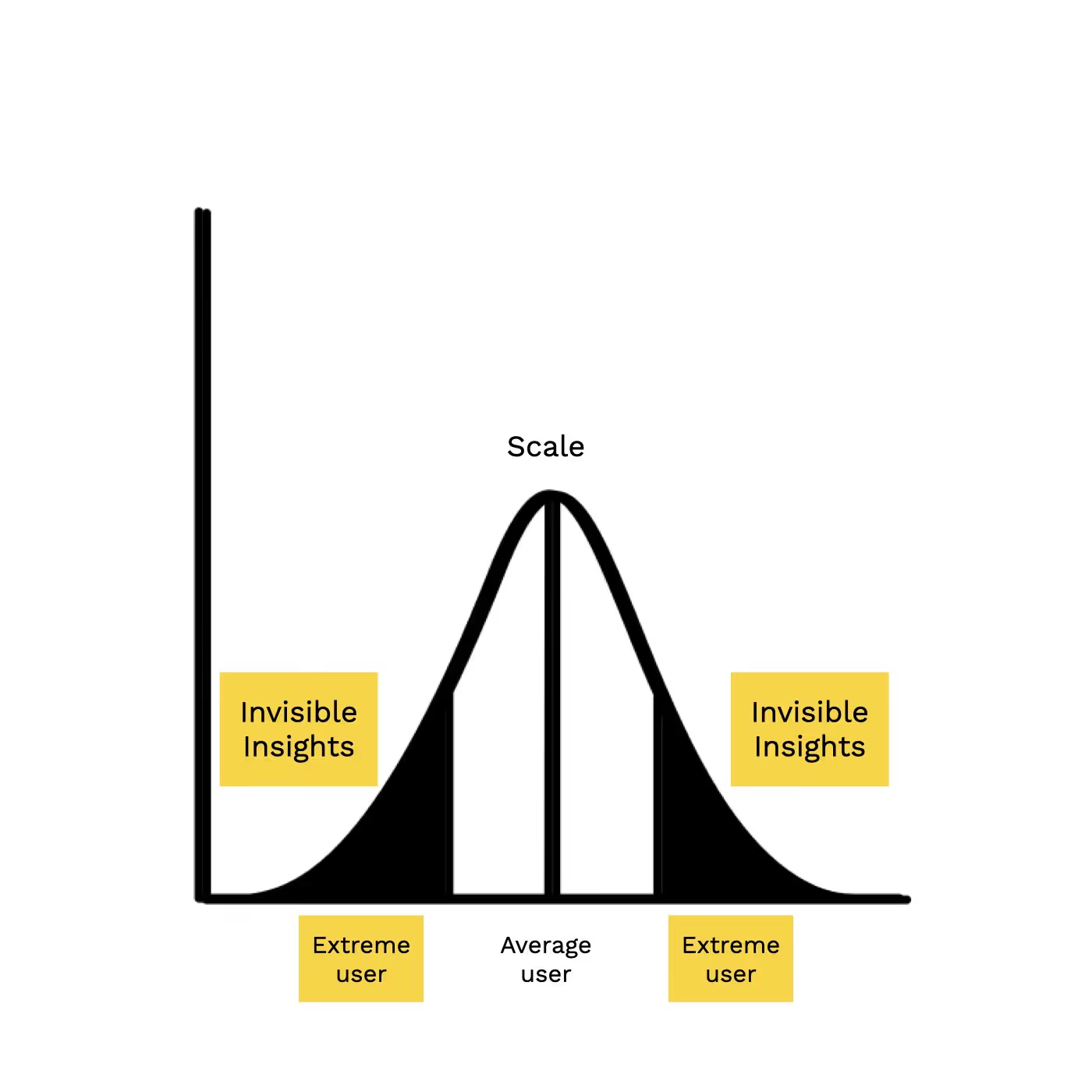
As we’re conducting an exploratory research wherein we’re seeking a divergent set of insights, we’re using a non-probability sampling method - a version of Judgement or Purposive sampling.
Our method of sampling involves arriving at a set of characteristics that would define an extreme user: a user with a unique set of challenges (for example: limited time, money, physical capacity, cognitive capacity), or a user who is in an environment that has an extremity (for example, accessibility issues, very tightly-knit community).
Extreme users enable us to conduct research with a limited few, for insights that would benefit the entire sample. This is a method that’s been pioneered by Don Norman.
And has led to some of the world’s greatest innovations.
One example is the OXO Good Grips vegetable peeler. It was designed by Sam Farber solely to address the problems that his wife (with arthritis) had with a stainless steel vegetable peeler, and it ended up becoming the best vegetable peeler the world has ever seen.
The reason for this is that while regular users might be our core audience from a scale standpoint, it’s the extreme user who will bring challenges & problems to the fore that no regular user would ever see or complain about. And so, by focusing on extreme users, we’re able to generate a lot more insights with a drastically lesser number of research units. In our experience, a number as low as 12 units could start showing an insight plateau, even for a Pan-India project.
One of the cardinal rules when speaking about behaviour & behaviour design is that context changes behaviour. However, on many occasions, this is misconstrued to mean that context changes with geography. There is this notion that one location is vastly different from another, at least visibly at the surface, and so, behaviours exhibited in each location will be starkly different. This is a rather simplistic view of how humans behave. And is possibly a case of overweighting the location variable over any other variable that might actually cause a difference in context & therefore, a difference in behaviour.
Through our research work & experience across a diverse set of sectors & industries, what we have noticed is that it’s more essential to consider the microcosm of context that each of our users is subject to, when making a specific decision. What are the various factors that influence the decision-making context for her. And these factors may not even be the same for every decision that she makes. Certain factors will be a bigger influence when she’s deciding what food to order (maybe her Need for Surety drives her to follow what her friend strongly recommends or she finds it safer to go with what she’s ordered multiple times). And a completely different set of factors could be influencing her when she’s buying a pair of jeans (maybe her Need for Respect gets her to look for a pair that has a brand name prominently displayed). As you can imagine, this leads to a large number of variables even within the same location! And this seems to be the actual way humans behave. Which is why we can’t ever expect 2 neighbours to behave in the same way in all their decision-making.
The error we’re trying to avoid is the broadly held view that people in a certain location will always behave in a certain way. Yes, this might be true if social proof was the dominant bias at play. But it’s highly unlikely that it’s the only factor, even in cases where it seems to be the dominant one. The more broadly you look at a location, the more likely you are to make assumptions that reflect the aggregate. And very often, this can be very very wrong for a certain individual in a certain decision-making context.
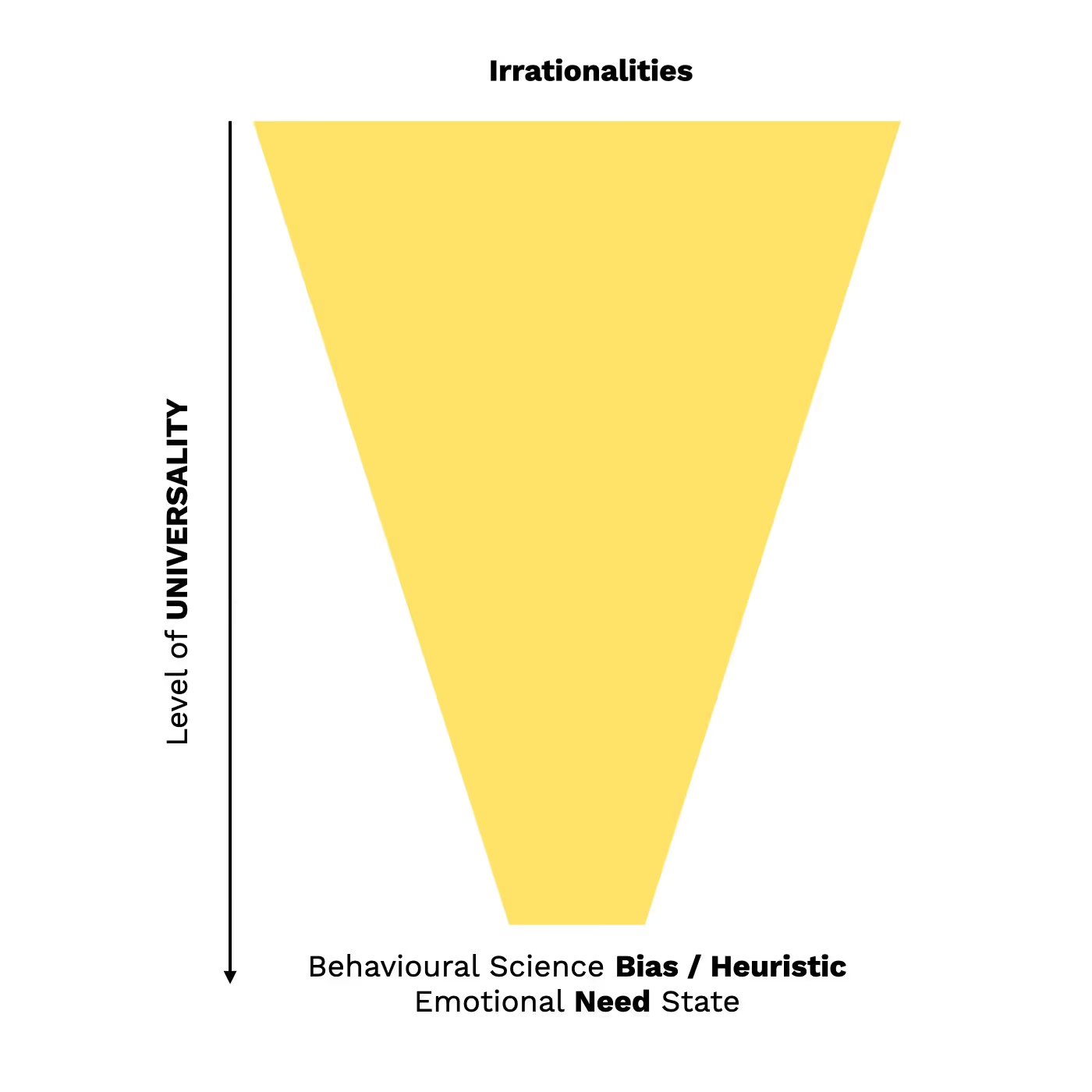
By studying extreme users even within a specific location, we intend to cover a wide range of visibly different behaviours (covering every single one will be almost impossible even in a multi-location study). These are users for whom one of the Needs has been more strongly compromised than it has for others. And in answering why a certain visible behaviour occurred, we arrive at 2 (invisible) hypotheses - the Behavioural Science bias or heuristic that explains how the person justified that behaviour in that specific context; and the inherent emotional need driving that person’s behaviour.
While the visible behaviours might be starkly different, because we’re studying a wide range of behaviours, we will arrive at a set of underlying reasons that remain more or less the same.
There might be some variability in which biases & needs tend to play out more strongly in which locations, but the extreme users, with different microcosms of context, will give us insights that should hold true across locations.
An analogy might help us frame this better - while at the surface it seems like food changes drastically from one location to another (between one country to another, between one state to another, between one city to another, between one neighbourhood to another & often, even within the same neighbourhood!) at its core it’s all a combination of carbs, proteins & fats in differing proportions. And that’s how we look at behaviours. Focusing more on what is causing these behaviours rather than the behaviour itself. This, we believe, enables solutions that are likely to be more universal in nature than tactical.
Taking the example of the OXO Goodgrips vegetable peeler, while the Need for Ease was more strongly felt by Betsy Farber because she had arthritis, it was a need that today resonates with every user in the world - with or without arthritis. While the universality of the solution in this case is almost utopian, we aim for a fraction of that kind of universality.
By designing solutions that address the biases & the emotional need states in a given context, we create solutions that are scalable even with a small research base. Of course, some geographies might be overweighted on a specific bias or need state, and certain tweaks could be needed at different locations (things we learn in the user testing phase of the process). But in having a solution that tackles barriers to satiating all the emotional need states, our solutions should be well-equipped for scalability.
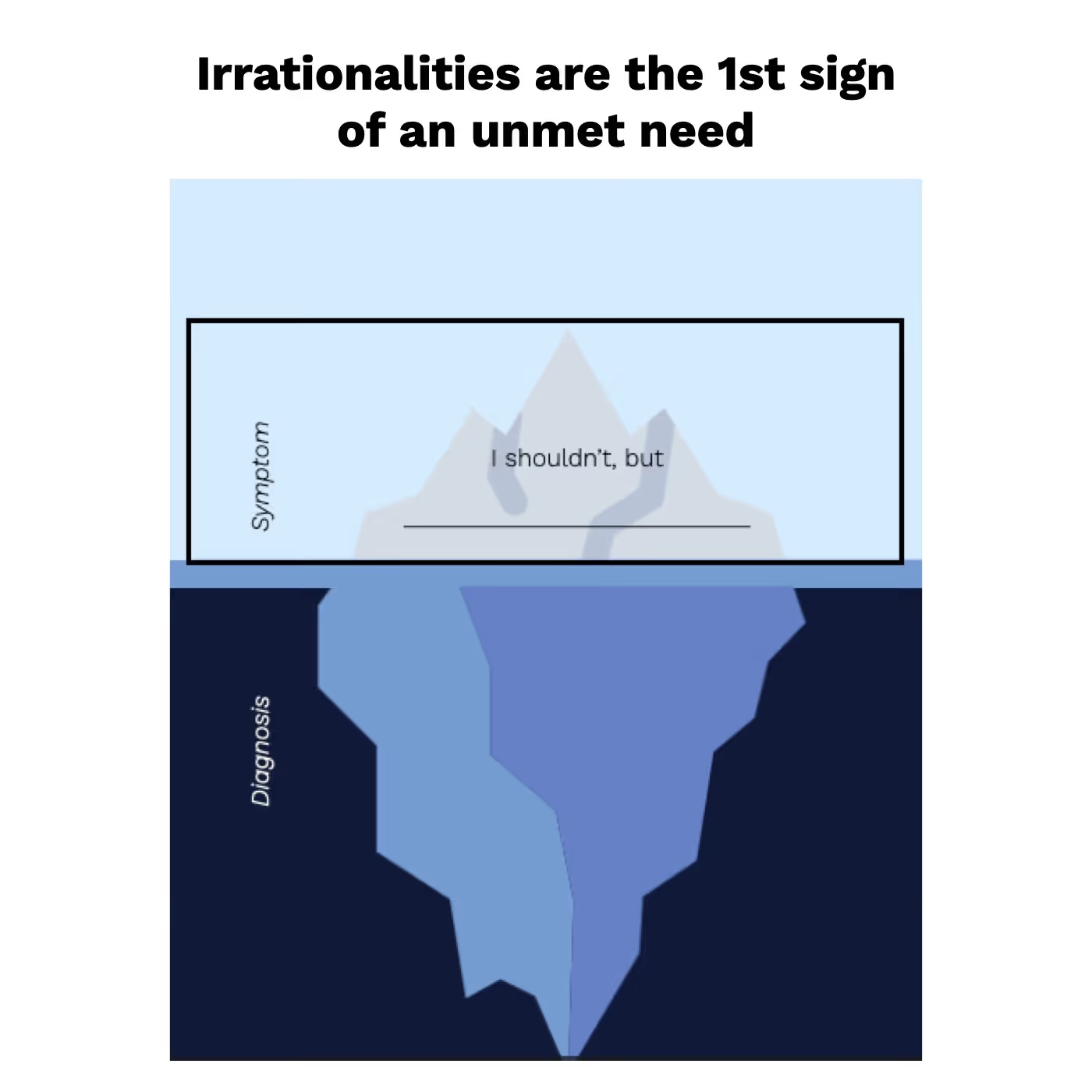
An irrationality is a behaviour that seems to violate absolutely rational behaviour. It is the difference between what Spock from Star Trek would do vs. what Homer from The Simpsons actually ends up doing. And this analogy is not meant as a jibe. But as a truthful, honest reflection of what makes us human. Because our brains are designed to work on power-saving mode rather than optimal-decision-making mode, we end up being driven by our System 1 brain a lot more than we expect (99.99% of the cases as per new reports). And that leads us to exhibiting irrational behaviours.
The way we articulate irrationalities is:
I shouldn’t but….
This simple framing helps us see the 1st sign of a latent user need that might be worth solving.
An irrationality is, after all, the 1st sign that something in the system or environment isn’t working the way it should.
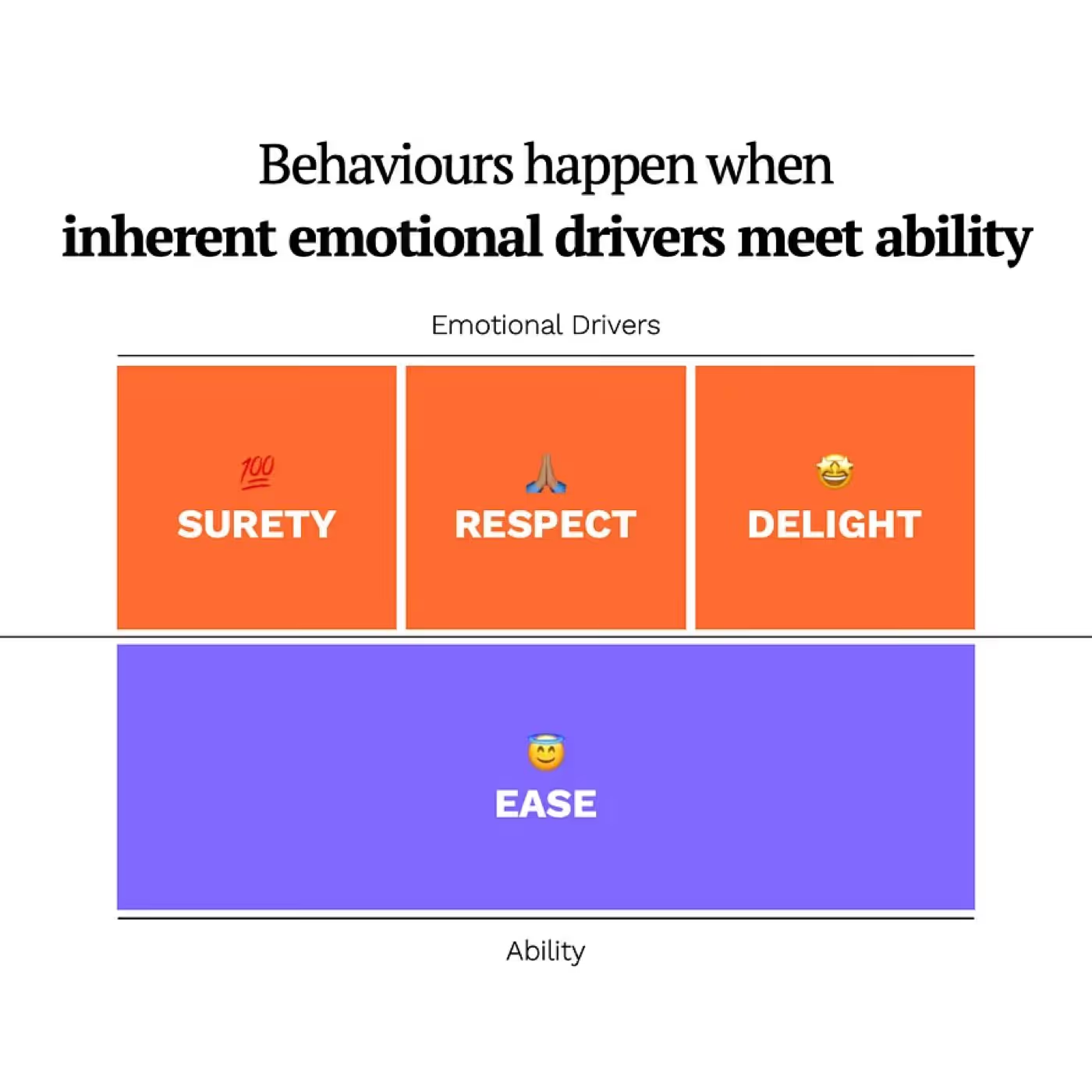
Behaviours happen when emotional drivers meet ability, i.e. when a system or an environment does 2 things - (1) satiates our emotional need for Surety, Respect & Delight. And (2) meets our ability to perform that behaviour (Ease).
Every irrationality that we observe is driven by 2 forces - an inherent emotional driver that this Need State Map covers.And a System 1 heuristic or bias.
The Need State Map gives us a good macro overview of the inherent emotional drivers that the system is currently meeting or failing - to cause the irrational behaviour.
And studying the gaps in this map shows us where latent-critical problems reside - to give us a hotbed of innovation opportunities.
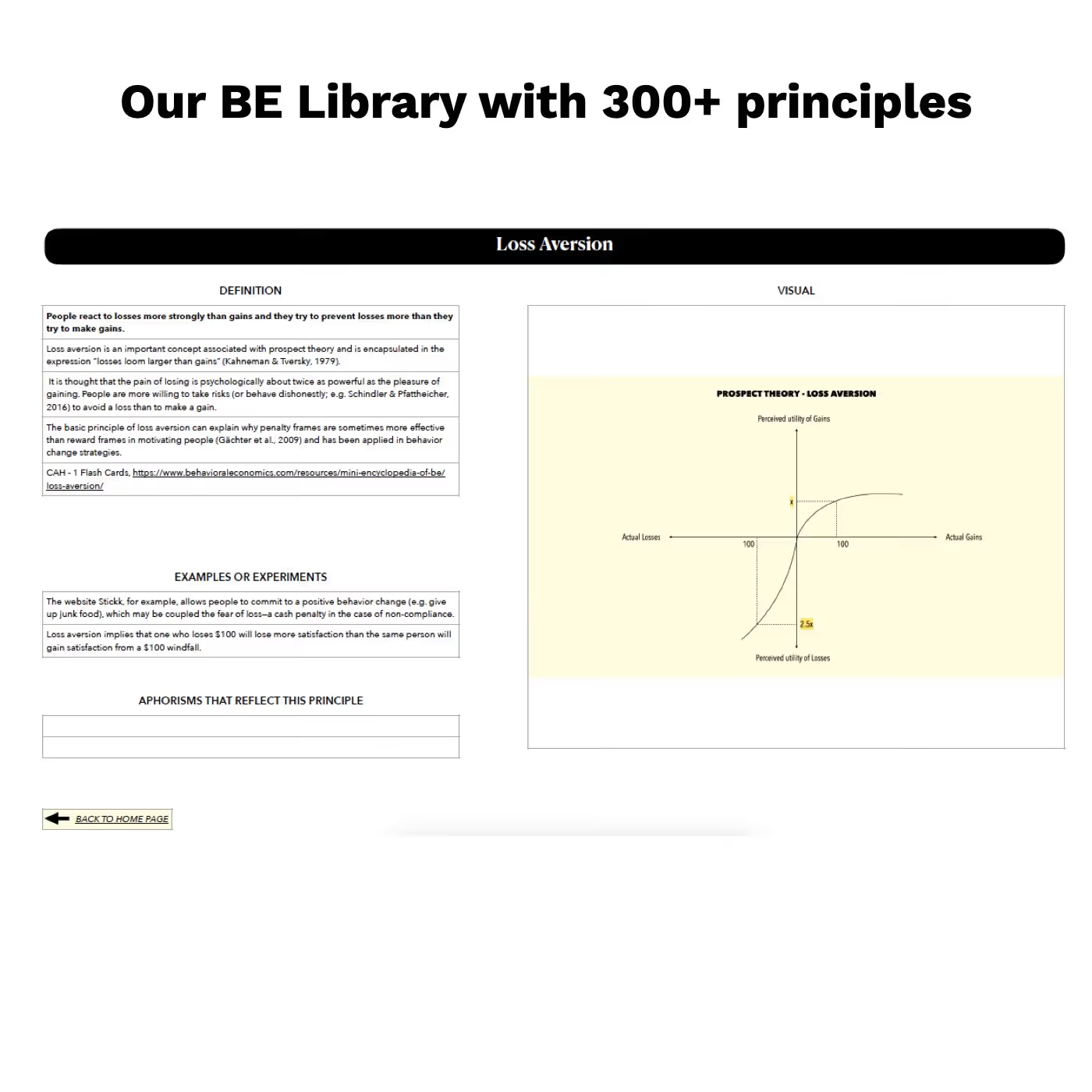
Just like a good doctor should have knowledge of all possible diagnosis so that her prescription can be more accurate, we believe that behaviour designers should understand all possible factors that could be at play.
Taking the doctor analogy forward, an irrationality is like a symptom you spot in the environment, and our BE Library helps us diagnose, more accurately, what possibly caused that irrationality.
We have curated our BE Library over a period of 4 years now.
And keep updating our document with new science (like Noise) as it comes along.
One of the big challenges faced in Behavioural Science is the need to reinvent & rename the same principles. A really annoying issue that is plaguing one and all - and leads to more surface-level diagnosis, owing to Choice Overload :D
We hope to solve that with this library of over 300 principles - even ones duplicated with different names.